July.17,2026
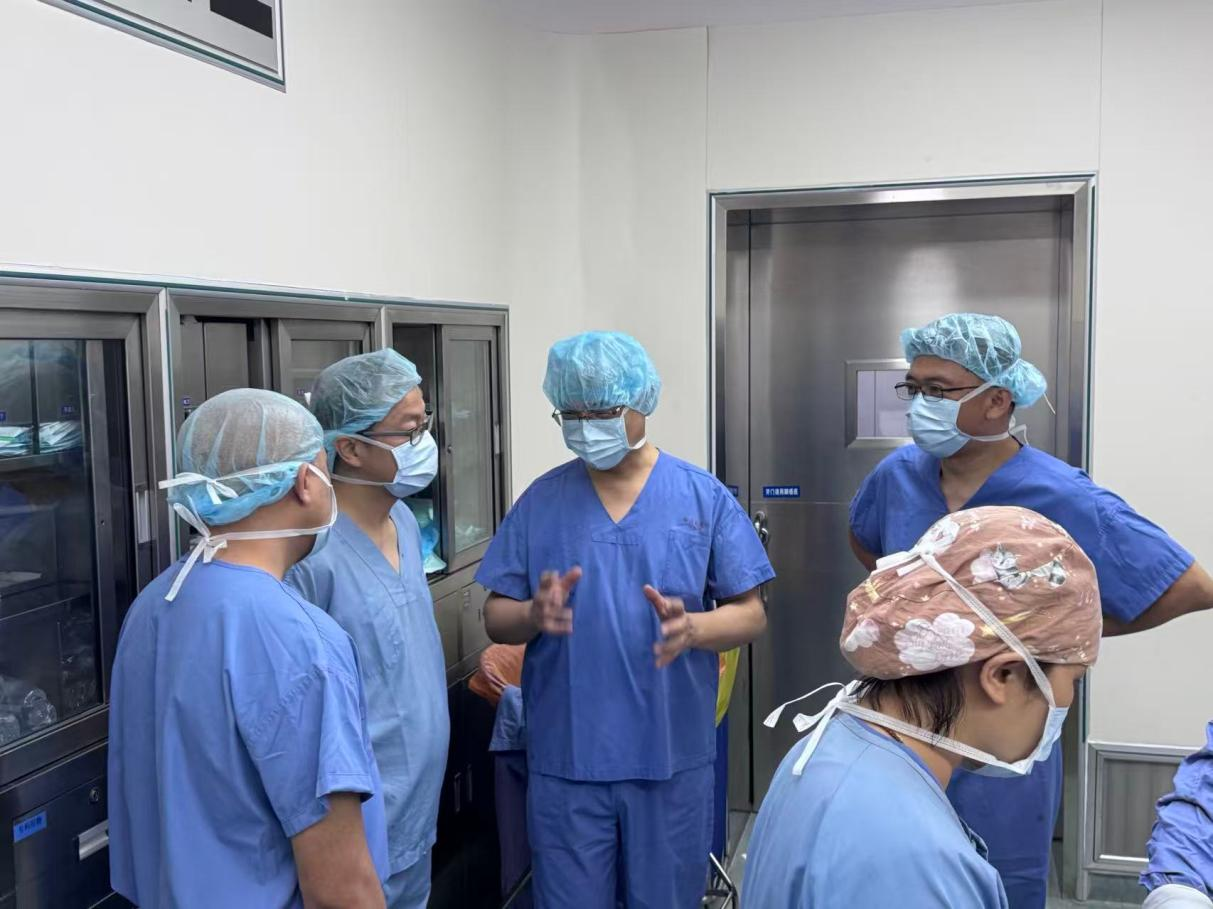
Robotic-Assisted Joint Replacement Surgery: Indonesian Experts Fly to Hangzhou for an Observation Visit
Read More→


 January.12,2026

A multidisciplinary research team from Zhejiang University has unveiled a novel "smart suture" system, potentially revolutionizing surgical wound closure by providing unprecedented, quantifiable control over knot tension. The findings were published in the prestigious journal Nature.
The innovation, termed "Sliputure," addresses a long-standing, fundamental challenge in surgery: achieving the optimal tightness when tying sutures. Conventionally, surgeons rely on visual estimation based on the degree of tissue deformation rather than on quantitative assessments. This reliance on subjective feel introduces variability, especially among less experienced surgeons and in robotic surgery where mechanical arms lack nuanced force feedback.
Spearheaded by academicians Cai XiuJun from Sir Run Run Shaw Hospital, affiliated with Zhejiang University School of Medicine, and Wei Yang from the Center for X-Mechanics, Zhejiang University, the team proposed an ingenious solution: encoding and transmitting precise force information using a "slipknot."
The core concept involves tying a slipknot at the end of a common knot. As the surgeon or robot pulls the suture to tighten the common knot, the accompanying slipknot begins to unravel. The precise moment this slipknot fully releases—occurring at a pre-determined, consistent peak force—signals that the dead knot has reached its ideal tension, preventing both under- and over-tightening.
A key technical difficulty was ensuring each slipknot unravels at a unique, predetermined, and highly consistent force. Achieving this required extensive interdisciplinary collaboration across mechanics, medicine, materials science, and robotics.
The team conducted systematic experiments, capturing the subtle sliding trajectories of slipknots using high-speed cameras and Micro-CT imaging. Through mechanical modeling and finite element simulation, they discovered that the force required to release a slipknot correlates precisely with parameters like pre-tightening force, the number of loops, diameter, friction coefficient, and material modulus. By meticulously adjusting these parameters, researchers can fabricate slipknots designed to release at any specific target force.
The team produced hundreds of these specialized sutures, each with a uniquely configured slipknot corresponding to different required closure forces for various surgical scenarios. In animal trials on intestinal repair—from open surgery in rats to laparoscopic and robotic procedures in pigs—the Sliputure successfully ensured anastomoses were both leak-proof and free from tissue tearing caused by excessive tension.
The technology's impact is significant. When integrated into endoscopes and surgical robots, it enables relatively inexperienced surgeons to improve their suturing force accuracy by 121%, with precision comparable to seasoned experts. Crucially, it allows robotic systems to perform reliable, real-time force control even without sophisticated force sensors.
The researchers are now building a database of optimal force values for different tissues, paving the way for developing a series of products applicable to robotic surgery and high-precision fields like gastrointestinal and cardiovascular operations.
Looking ahead, the underlying principle of this mechanically intelligent system, which eschews complex electronics, holds promise for deep-cavity surgeries and operations under other extreme conditions, potentially extending its utility far beyond current clinical applications.