June.26,2026
July.17,2026
Robotic-Assisted Joint Replacement Surgery: Indonesian Experts Fly to Hangzhou for an Observation Visit
Read More→


New combination therapy offers a second chance for a 58-year-old man, rewriting the course of his disease.
Mr. Liu, 58 years old, had been diagnosed with highly aggressive intrahepatic cholangiocarcinoma in its late stage. A 5‑cm tumor had wrapped itself like a claw around his hepatic artery and portal vein, and had spread like ivy to the lymph nodes along his colon. Multiple specialists had told him, “this is inoperable.”
In despair, the family sought one final opinion from the team led by Dr. Cai Xiujun, an Academician of the Chinese Academy of Sciences and President of Sir Run Run Shaw Hospital affiliated with Zhejiang University School of Medicine (SRRSH). There, they were offered a novel therapy—and a turning point in their journey.
Far from Hopeless: Novel Therapy Opens a New Path
At the initial consultation, Mr. Liu’s daughter asked tearfully, “Is there nothing left but to go home and wait?” Academician Cai carefully reviewed every image. Pointing to the CT scan where the tumor tightly encased the blood vessels, he said: “Conventional surgery is indeed not feasible. But we have a new approach.”
This approach is a strategy that uses a combination of drugs to shrink, inactivate, and reduce advanced, initially unresectable tumors, turning a “late-stage” cancer into a “mid-stage” one, and changing “inoperable” into “operable.”
After a thorough discussion, the Liu family decided to proceed.
A Precision “Smart Bomb” Changes the Trajectory
Dr. Cai’s team immediately convened a multi‑disciplinary MDT meeting to bring together experts from hepatobiliary‑pancreatic surgery, radiology, and translational medicine. The search for a breakthrough began with histopathology from a liver biopsy. The results revealed that the tumor cells had high expression of a target called EGFR. “We have a target! We can use an ADC drug.”
What is an ADC drug? Think of it as a smart missile. The “warhead” is a potent chemotherapy agent, but it is encased in a “guidance system”—an antibody that precisely recognizes the EGFR target. Once inside the body, this “missile” does not indiscriminately damage normal cells; instead, it locks onto cancer cells, penetrates them, and detonates from within.
The team combined this with the classic Gemox regimen (gemcitabine plus oxaliplatin) and a PD‑1 immune checkpoint inhibitor, tailoring a three‑pronged protocol: “chemotherapy sensitisation + targeted killing + immune activation.” The goal was singular: to force the tumour into “submission”.
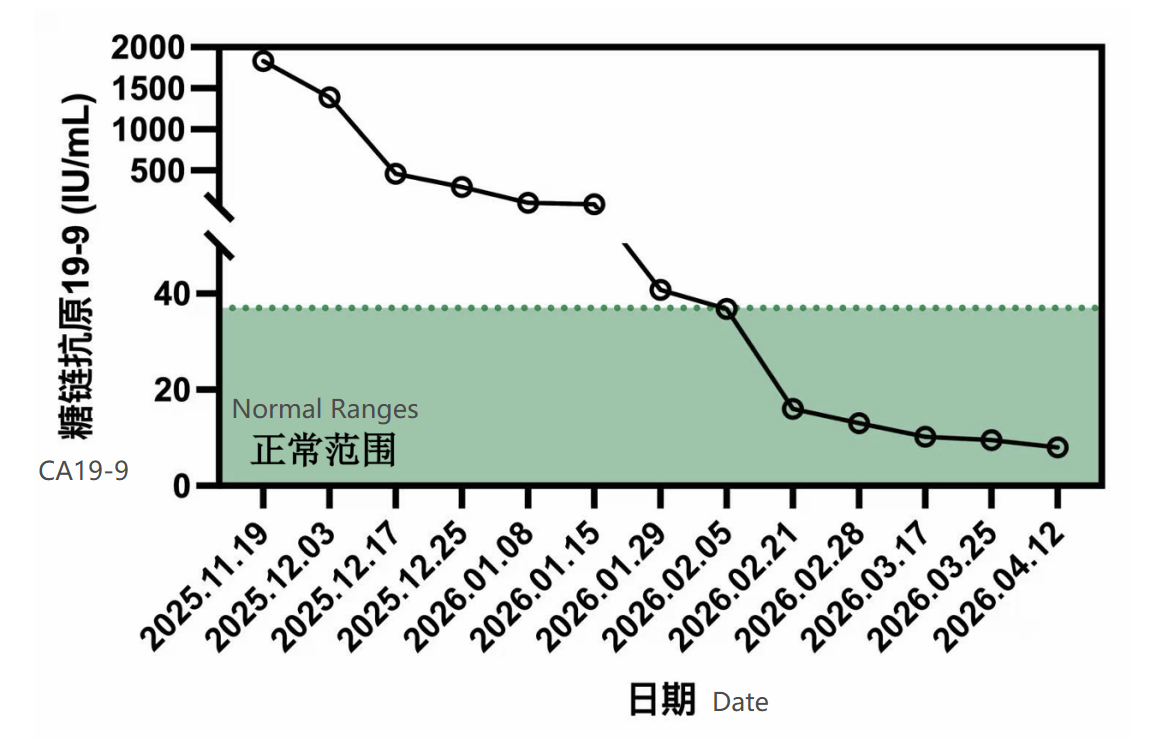
From December 2025 to March 2026, Mr. Liu completed six cycles of treatment. Fortunately, he tolerated the therapy well; his liver function and all key indicators remained stable, with no severe side effects.
On April 13, 2026, a follow‑up examination arrived—a day filled with anxiety. The results, however, were stunning:
· The liver tumour had shrunk from 5 cm to just 1 cm;
· The hepatic artery and portal vein, previously encased by the tumour, had returned to normal;
· All metastatic lymph nodes had disappeared;
· The CA19‑9 tumour marker had plummeted from 1,832 to 7.97.
His daughter broke down in tears. Mr. Liu grasped the doctor’s hand and said simply: “I get to live again.”
Robotic Minimally Invasive Surgery: Less Than 10 ml Blood Loss
The timing for surgery was now right. On April 14, 2026, Dr. Cai’s team performed a robot‑assisted laparoscopic partial hepatectomy on Mr. Liu. Using the da Vinci surgical system’s 3D magnified vision and intelligent tremor‑filtering technology, the surgeons completely resected the remaining 1‑cm tumour focus and cleared all suspicious lymph nodes. Intraoperative blood loss was less than 10 ml, and no blood transfusion was required.
By the first postoperative day, Mr. Liu was already out of bed. His liver function recovered steadily, and no serious complications occurred. A patient once given a “death sentence” for advanced bile duct cancer had walked back from the brink.
Many believe that once bile duct cancer envelops major vessels or metastasises to lymph nodes, all hope is lost. But Mr. Liu’s story demonstrates that with the relentless progress of precision oncology, even aggressive late‑stage tumours can achieve favorable outcomes and offer patients a strong prognosis. Mr. Liu is not an isolated case. Under the care of Dr. Cai Xiujun’s team at SRRSH, a growing number of patients with advanced bile duct cancer, pancreatic cancer, and liver cancer are regaining their lives through this “conversion‑then‑surgery” pathway.